
Summary
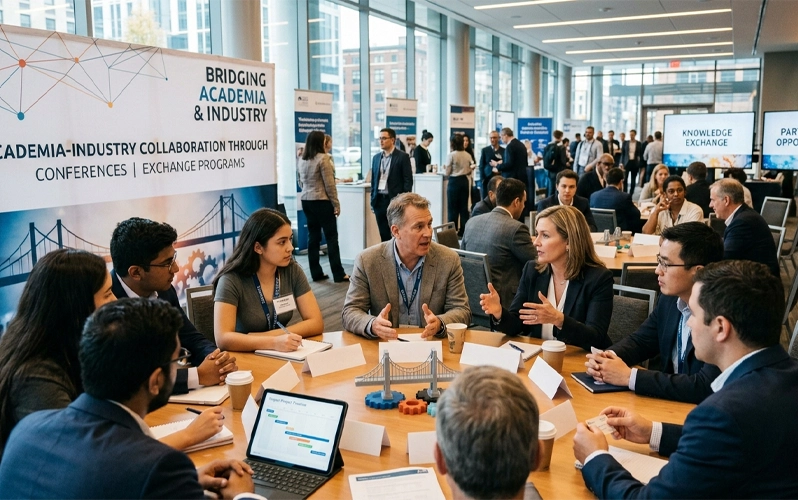
Spend enough time with deans, training heads, and HR leaders, and you will hear the same quiet admission — just worded differently depending on which side of the table they are sitting on. Everyone agrees in principle. Then the call ends, the email thread grows quiet, and day-to-day work takes over again. In that gap between intention and follow-through, Academia-industry collaboration through conferences has become one of the few moments when people actually sit across from each other and talk. Handled with care, Academia-industry collaborations also give both sides a safe way to test how ready they are to work together in practice. This blog looks at what can happen when collaboration through conferences is treated as a working tool, not a formality. It draws on the kinds of rooms we see as a destination management partner: mixed groups of faculty, students, and company teams trying to make limited time count.
Table of Contents
- 1. Why We Keep Bringing Academia and Industry Together
- 2. What Really Happens in the Conference Hall
- 3. Designing Conferences Around Honest Conversations
- 4. Students at the Center of the Room
- 5. From One Event to Ongoing Exchange Programs
- 6. Measuring Whether Anything Truly Changed
- 7. Why Destinations and Hosts Shape the Outcome
- 8. Frequently Asked Questions
1. Why We Keep Bringing Academia and Industry Together
Every conference we support starts with a familiar conversation. A university wants its graduates to be more workforce-ready. A company wants to stop spending months re-training new hires. The concern underneath is always the same — nobody wants to find out too late that something got lost between the classroom and the real world.
That is honestly why academia-industry collaboration through conferences still holds so much value. It is one of the few spaces where faculty, students, recruiters, and managers are genuinely in the room together — not on a call, not in a report, but in the same space. And when that happens, real signals show up fast. Who lingers after a session? Whose question makes everyone go quiet? Those moments are hard to manufacture anywhere else.
2. What Really Happens in the Conference Hall
On paper, agendas look polished. In reality, conferences are less tidy. Speakers run over time, technology fails, and the most useful insight often comes from someone who was never meant to be the main voice in the room.
Early conversations stay formal. Industry speaks about “future-ready talent.” Universities speak about “innovation” and “research.” But as the day continues, the language becomes more direct. A recruiter admits that candidates struggle when a client challenges them. A faculty member shares that students avoid group work because past team experiences went badly.
That is where academia-industry collaboration through conferences becomes useful. The value is not only in the official theme. It appears when someone says, plainly, “Here is what is actually difficult for us.” That is also when academic-industry partnership conferences begin to earn their time and cost.
3. Designing Conferences Around Honest Conversations
Conference design matters more than most organizers expect.
A common mistake is over-programming. Organizers try to cover every topic and include every speaker. The result is a packed schedule with no time to reflect or continue a strong conversation. In that format, academia-industry collaboration through conferences can feel active without being useful.
A stronger approach is to build the day around a few questions that both sides genuinely care about:
Will our graduates be able to write emails that clients actually understand?
Are we teaching tools that companies have already moved past?
Where do student projects genuinely add value, and where are they creating work without outcomes?
When a conference is shaped around questions like these, the room changes. Panels can be shorter. Case studies matter more than vision statements. Small-group sessions become more honest than large formal ones.
4. Students at the Center of the Room
Students are often the stated focus of these events, yet in many collaborative academic events , they remain in the audience rather than at the table.
The more effective conferences give them a real role. That means asking students to speak honestly about what worked in internships—and what did not. It can also mean letting student teams discuss a live problem with company mentors in front of the room. In a short session, employers can learn more about readiness and communication than they would from a stack of resumes.
This is also where industry-academia exchange programs often begin. A manager who sees a student handle a difficult question well is more likely to imagine that student in a real project. A faculty member who notices where students struggle may revise assignments the following semester.
5. From One Event to Ongoing Exchange Programs
Every conference ends with the same good intentions: “We should continue this conversation.” The real question is what happens after people go home.
Useful industry-academia exchange programs usually begin with something smaller than a grand partnership announcement. One executive co-teaches a short module. One company offers a clearly scoped student project with a named mentor. One research team asks practitioners for feedback before publication.
These steps are not dramatic, but they often grow out of academia-industry collaboration through conferences that put the right people together at the right time. Over time, repeated small efforts build trust. Event-only relationships fade quickly. Working relationships built through teaching, projects, and follow-up tend to last.
6. Measuring Whether Anything Truly Changed
The impact of a conversation is difficult to measure, but not impossible to quantify. Six months after an event, leaders can ask a few simple questions.
This is where a destination management company becomes central to corporate academic partnerships. A good partner does more than confirm hotels and transport. It helps both sides turn broad aims into a plan that can work for real people on the ground.
Has any syllabus changed because of what was discussed? Are internship or job applications from that institution different in quality? Did any proposed project move beyond the planning stage?
https://www.vesnatours.com/blog/wp-admin/profile.php
If the answer is no, the next event needs a different structure. If the answer is yes, even in modest ways, it is worth naming that progress clearly. Knowledge exchange programs become credible when people can trace a line from one year’s discussion to the next year’s change.
That is the real test of knowledge exchange programs and academic-industry partnership conferences: not whether the event felt good in the moment, but whether it changed teaching, hiring, or collaboration afterward.
7. Why Destinations and Hosts Shape the Outcome
Place shapes outcomes more than most strategy documents admit.
A conference beside an airport feels different from one held on a campus or in a working innovation hub. Long transfers drain energy. Short distances make it easier for conversations to continue after sessions end. Good hosts know which company visits will feel honest instead of staged and which venues support useful discussion rather than rushed movement.
When destination partners and institutions are involved early, academia-industry collaboration through conferences becomes easier to plan realistically. Over time, some locations become known for grounded, useful collaborative academic events rather than glossy but exhausting ones. That reputation comes from small decisions about venue, timing, and flow—not slogans.
8. Frequently Asked Questions
1. How can a smaller institution make academia-industry collaboration through conferences effective?
Start small and stay specific. Focus on one issue, invite a few relevant companies, and build trust through a well-run event.
2. What is a realistic first step after a good conference?
Start with one manageable experiment, such as a guest-taught module, a student project, or a job-shadowing week. Small wins often grow into stronger industry-academia exchange programs.
3. How should students be involved during these events?
Give them active roles. Let them share project stories, join mixed panels, and ask direct questions in smaller discussions.
4. How do we know if our knowledge exchange programs are working?
Review outcomes six months later. If syllabi changed, projects started, or employers still refer to those discussions when making decisions, the knowledge exchange programs are working.